
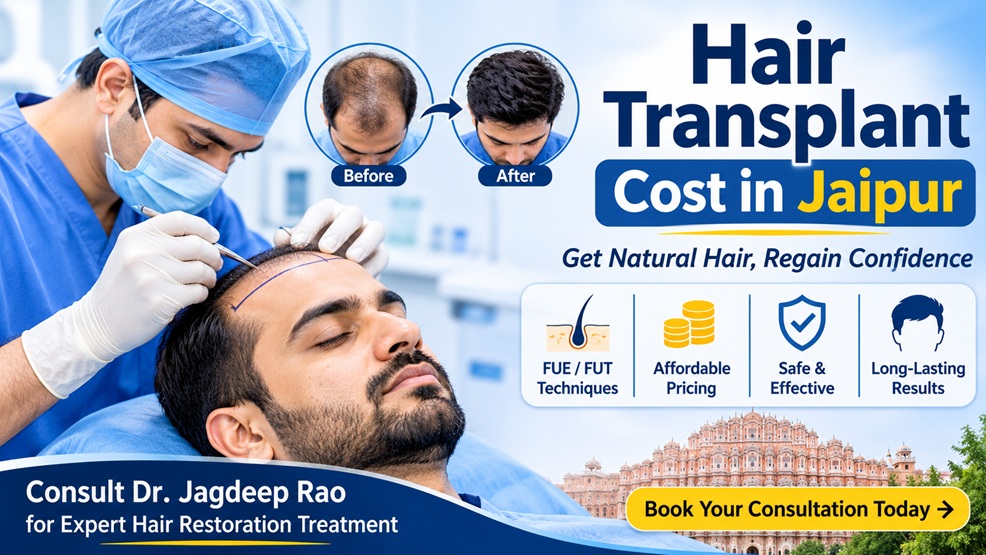
Hair Transplant Cost in Jaipur: 7 Important Factors to Know
Hair Transplant Cost in Jaipur is one of the first things people consider when planning a hair restoration procedure. Hair loss, receding hairlines, bald patches, and thinning hair can affect confidence and appearance. A hair transplant is a surgical procedure that moves hair follicles from a donor area, usually the back or sides of the scalp, to areas affected by hair loss.
The total cost depends on several factors, including the number of grafts required, the selected technique, the surgeon’s experience, and the facilities provided by the clinic or hospital.
If you are considering a hair transplant in Jaipur, this guide will help you understand estimated prices, different techniques, graft requirements, recovery, and important points to consider before choosing treatment.
Table of Contents
What Is a Hair Transplant?
Hair Transplant Cost in Jaipur
Hair Transplant Cost Per Graft
7 Factors Affecting Hair Transplant Cost
Types of Hair Transplant Techniques
How Many Grafts Do You Need?
Hair Transplant Recovery
How to Choose the Right Hair Transplant Surgeon
Frequently Asked Questions
What Is a Hair Transplant?
A hair transplant is a surgical hair restoration procedure in which hair follicles are taken from a donor area and implanted into areas experiencing hair loss or baldness.
It is commonly considered for people experiencing male pattern baldness, receding hairlines, thinning crowns, and certain types of hair loss caused by injuries or scars.
The surgeon examines the scalp, evaluates donor hair availability, and plans the hairline and graft distribution according to the patient’s needs.
Hair Transplant Cost in Jaipur
The Hair Transplant Cost in Jaipur varies depending on the technique, graft count, and treatment requirements.
As an indicative 2026 market estimate, standard FUE procedures in Jaipur may cost approximately ₹25–₹55 per graft. A procedure involving around 2,000–2,500 grafts may cost approximately ₹50,000–₹1,40,000 before applicable taxes and additional charges.
These are general market estimates, not the confirmed fees of Dr. Jagdeep Rao or any particular clinic.
Estimated Hair Transplant Cost by Technique
| Hair Transplant Technique | Estimated Cost Per Graft |
|---|---|
| FUT Hair Transplant | ₹20–₹35 |
| FUE Hair Transplant | ₹25–₹55 |
| DHI Hair Transplant | ₹45–₹90 |
| Sapphire FUE | ₹35–₹70 |
Prices vary between clinics and depend on the procedure and services included in the package.
Estimated Hair Transplant Cost by Graft Count
| Number of Grafts | Estimated FUE Cost |
|---|---|
| 1,000–1,500 Grafts | ₹25,000–₹85,000 |
| 2,000–2,500 Grafts | ₹50,000–₹1,40,000 |
| 3,000–3,500 Grafts | ₹65,000–₹1,65,000 |
The actual graft requirement is decided after examining the donor area, hair loss pattern, and desired coverage.
7 Factors Affecting Hair Transplant Cost in Jaipur
Several factors determine the final Hair Transplant Cost in Jaipur. Understanding these factors can help you compare treatment plans more effectively.
1. Number of Hair Grafts Required
The number of grafts is one of the most important factors affecting the total price.
A patient with a slightly receding hairline may need fewer grafts than someone with extensive baldness involving the front, middle scalp, and crown.
The surgeon estimates the graft requirement after evaluating the scalp and donor area.
2. Hair Transplant Technique
Different hair transplant techniques involve different surgical approaches, equipment, and operating time.
FUE, FUT, DHI, and Sapphire FUE may have different pricing structures. The most suitable technique depends on the patient’s condition rather than price alone.
3. Surgeon’s Experience and Expertise
The surgeon’s qualifications, surgical experience, and involvement in the procedure are important considerations.
Patients should ask who performs the extraction, site creation, and implantation. They should also discuss hairline design, donor-area management, and expected results.
4. Donor Area Condition
The donor area usually includes the back and sides of the scalp. Its density, hair thickness, and available follicles influence the treatment plan.
Limited donor hair may require careful graft distribution and realistic expectations.
5. Clinic and Hospital Facilities
The facility, operating room, medical equipment, nursing support, and safety arrangements can influence the overall cost.
Always check the hygiene standards and medical support available at the treatment centre.
6. Additional Treatments and Medicines
Some patients may be advised medical treatment or additional procedures depending on the cause and pattern of hair loss.
Consultation, blood tests, medicines, PRP sessions, and post-operative care may be charged separately.
7. Follow-Up and Post-Surgery Care
Hair restoration requires follow-up and proper aftercare.
The clinic may recommend check-ups, scalp-care instructions, medicines, and monitoring of hair growth. Ask whether these services are included in the quoted price.
Types of Hair Transplant Techniques
Choosing the appropriate technique is an important part of hair restoration planning.
FUE Hair Transplant
FUE stands for Follicular Unit Extraction. In this method, individual hair follicular units are extracted from the donor area and implanted into the recipient area.
Common features include:
Individual follicle extraction.
Small extraction sites.
No long linear donor scar.
Suitable for many hair restoration cases.
The cost depends on graft count, surgical planning, and clinic facilities.
FUT Hair Transplant
FUT stands for Follicular Unit Transplantation. In this technique, a strip of scalp tissue is removed from the donor area, and individual follicular units are prepared for transplantation.
It may be considered in selected patients depending on donor availability and surgical requirements.
A linear scar generally remains in the donor area.
DHI Hair Transplant
DHI stands for Direct Hair Implantation. It is a technique in which extracted follicles are implanted using a specialised implanter device.
The suitability of DHI depends on the patient’s scalp condition, treatment goals, and the surgeon’s assessment.
Sapphire FUE
Sapphire FUE is a variation of FUE that uses sapphire blades for creating recipient sites.
The technique may influence the procedure’s pricing, but a more expensive technique does not automatically guarantee better results.
How Many Grafts Do You Need for a Hair Transplant?
The number of grafts depends on the extent of hair loss, donor hair availability, hair characteristics, and desired coverage.
The following figures are broad examples, not individual treatment recommendations.
| Hair Loss Area | Illustrative Graft Requirement |
|---|---|
| Minor Hairline Recession | 800–1,500 |
| Front Hairline and Temples | 1,200–2,000 |
| Front and Mid-Scalp | 1,800–3,000 |
| Extensive Baldness | 3,000–4,000+ |
One graft can contain one or more hair follicles. Therefore, graft count and individual hair count are not the same.
A proper scalp examination is necessary to estimate the number of grafts safely.
Hair Transplant Recovery: What to Expect
Recovery differs from patient to patient. Following the surgeon’s instructions is important for proper healing.
First 3–7 Days
Mild swelling, redness, tenderness, and small scabs may appear around the treated areas. Follow the recommended washing and medication instructions.
First 2 Weeks
The scalp gradually heals. Patients should avoid rubbing, scratching, or putting unnecessary pressure on the transplanted area.
First 1–3 Months
Some transplanted hair may shed during the early recovery period. This is commonly called shock loss or shedding and does not necessarily mean the transplant has failed.
3–6 Months
New hair growth may gradually become visible. Growth patterns and timing vary between individuals.
6–12 Months
Hair density and appearance generally continue improving. Final results may take 12 months or longer, depending on the patient and treatment area.
How to Choose the Right Hair Transplant Surgeon in Jaipur?
Selecting the right surgeon is more important than choosing the lowest advertised price.
Before deciding on treatment, consider these points:
Check the surgeon’s medical qualifications and registration.
Ask about experience in hair restoration surgery.
Discuss the FUE, FUT, or DHI technique recommended for you.
Understand who will perform each part of the procedure.
Ask about donor-area limitations and possible risks.
Request a written cost estimate.
Understand the follow-up and recovery plan.
Avoid making decisions based only on advertisements or guaranteed hair growth claims.
Why Consult Dr. Jagdeep Rao for Hair Transplant Treatment?
Dr. Jagdeep Rao is a Plastic and Cosmetic Surgeon in Jaipur with qualifications including MBBS, MS (General Surgery), and MCh (Plastic & Cosmetic Surgery).
He also has experience in plastic and cosmetic surgery and provides consultations for patients considering hair restoration procedures.
During a consultation, patients can discuss their hair loss pattern, donor area, suitable treatment options, expected graft requirements, and estimated cost.
The recommended procedure and final treatment plan depend on an individual medical assessment.
Frequently Asked Questions About Hair Transplant Cost in Jaipur
1. What is the average Hair Transplant Cost in Jaipur?
The cost varies by clinic and technique. As an indicative estimate, FUE may cost around ₹25–₹55 per graft in Jaipur. The total depends on the number of grafts and services included.
2. How much does a 2,000-graft hair transplant cost in Jaipur?
A 2,000-graft FUE procedure may cost approximately ₹50,000–₹1,10,000 based on an indicative range of ₹25–₹55 per graft. The final quotation depends on the clinic and treatment plan.
3. Is FUE better than FUT?
Both techniques have advantages and limitations. FUE involves individual follicle extraction, while FUT involves removing a strip of scalp tissue. The appropriate option depends on donor hair, scalp condition, and the surgeon’s assessment.
4. Is DHI more expensive than FUE?
DHI may cost more than standard FUE because of the specialised implantation method and equipment. However, the best technique depends on individual requirements.
5. Is a hair transplant permanent?
Transplanted follicles can provide long-lasting growth, but existing non-transplanted hair may continue thinning. Long-term planning and medical follow-up may be necessary.
6. How long does a hair transplant procedure take?
The duration depends on the number of grafts, surgical technique, and complexity. A larger session generally requires more operating time.
7. When can I see the final hair transplant results?
Hair growth takes time. Initial growth may appear after a few months, while fuller results commonly develop over approximately 12 months or longer.
Conclusion
Understanding the Hair Transplant Cost in Jaipur helps patients make informed decisions about hair restoration. The total expense depends on graft requirements, surgical technique, surgeon’s experience, clinic facilities, and post-operative care.
Before choosing a procedure, consult a qualified surgeon, understand the available options, and request a detailed cost estimate based on your scalp examination.
Book a Consultation with Dr. Jagdeep Rao in Jaipur to discuss your hair loss concerns, suitable treatment options, graft requirements, and personalised hair restoration plan.